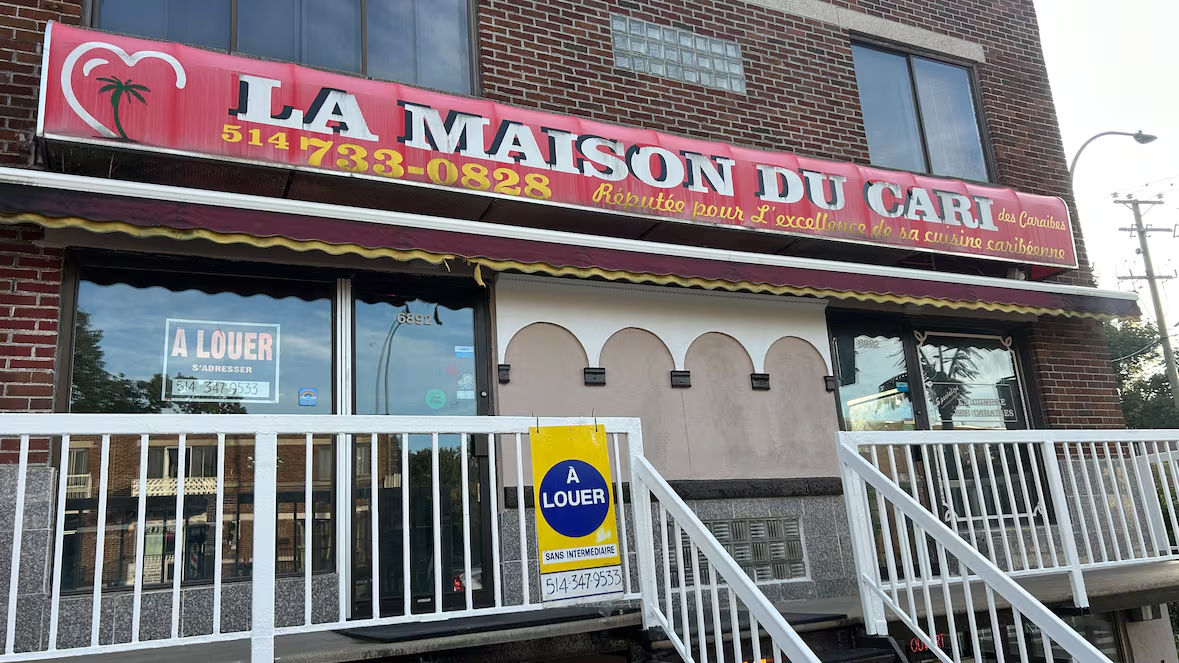
The Caribbean Curry House, a fixture in Montreal’s Côte-des-Neiges neighbourhood for more than four decades, has permanently closed its Victoria Street location, leaving many in the city’s Caribbean community mourning the loss of what several described as a genuine community hub.
Owner Colin Bentley confirmed the closure earlier this month, telling CBC that rising costs ultimately forced his hand. He said the restaurant had been losing money for some time amid a more competitive market, and that the aging building itself had become a financial burden. Bentley said he had to replace heating equipment that was roughly 70 years old, an expense he described as falling entirely on him. “If it wasn’t Caribbean Curry House, I would have closed it a year ago,” he said, adding that he had hoped to sell the business to keep the Victoria Street location running, but was unable to find a buyer.
A gathering place beyond the menu
The restaurant opened in 1980 and became known for its roti, jerk chicken, rice and peas, and Jamaican patties. Sharon Nelson, president of the Jamaica Association of Montreal, called it “a piece of Trinidad in Montreal” for anyone looking for good roti, and recalled watching the roti-making process as one of her fondest memories of the place.
But for many, the Caribbean Curry House was about more than food. Ledon Anthony John, who owns a nearby hair and nail salon, said the restaurant’s name captured exactly what it meant to the neighbourhood. “Caribbean Curry House – so it’s a home away from home, that’s what it meant to me,” he said, recalling meeting family and friends there over the years.
Broadcaster and actress Pat Dillon-Moore, who has long ties to Montreal’s Caribbean community, said the restaurant’s roots trace back to the late 1960s, when many Caribbean families left Montreal’s Little Burgundy area due to urban renewal projects, including construction of the Ville-Marie Expressway. Displaced students and professionals found affordable housing in Côte-des-Neiges, and Victoria Street quickly became what she called “our business street or our corridor of business.”
From Friday night shows to World Cup nights
Dillon-Moore remembered the restaurant in its heyday as a place where people didn’t just eat but gathered for meetings, community activities, and Friday evening entertainment that, in summer, would spill out onto Victoria Street itself. She recalled one especially vivid memory from 2006, when the restaurant was packed with fans cheering for Trinidad during a FIFA World Cup match against England. “Trinidad lost that day, but we made enough noise. It felt like they won,” she said.
The original owners retired and sold the business in 2019. Dillon-Moore said the sale brought both sadness and hope at the time, since the restaurant reopened under new ownership rather than disappearing altogether. Still, she said, it never fully regained the atmosphere and energy it once had as a neighbourhood hub.
Concerns over the loss of Black-owned businesses
John said news of the closure carries weight beyond the loss of a single storefront. “When we lose these businesses, we’re not just losing storefronts, we’re losing pieces of our history, culture, identity, and community,” he wrote in a social media post following the announcement. He said he hopes whoever eventually takes over the Victoria Street space will recognize its significance and keep it connected to the Caribbean community.
Bentley said a newer Caribbean Curry House location in Dollard-des-Ormeaux, in Montreal’s West Island, remains open for customers wanting Caribbean curry dishes, even as the original Victoria Street site that anchored the community for 45 years has now shut its doors for good.
This article references reporting from: