For the first time since the depths of the 2008-09 financial crisis, every Canadian province that has tabled a budget this year is projecting a deficit for 2026-27. That is not a coincidence of bad luck or a single shared shock — it is the cumulative result of years of rising health-care costs, lingering inflation in government contracts and wages, and now a fresh layer of uncertainty from the U.S. trade war. As Ottawa prepares its own spring fiscal update on April 28, the provincial numbers already in hand tell a story that complicates the usual excuse-making: according to the Business Council of Canada, this year’s fiscal deterioration is ‘the result of higher spending, not weaker revenues.’
A Season of Red Ink Across the Country
The scale of the shift is unusual by historical standards. The Business Council of Canada’s analysis, written by a former economic advisor to Ontario Finance Minister Peter Bethlenfalvy, notes that the last time every province ran a deficit was at the height of the 2008-09 Global Financial Crisis, and the last time every province recorded back-to-back deficits was during the severe early-1990s recession. This time, there is no comparable recession driving the numbers. RBC Economics’ fiscal roundup, consolidating budgets from nine of ten provinces, puts the combined provincial deficit at 1.1% of GDP in 2025-26, holding steady at 1.1% of GDP in 2026-27 — a full 0.6 percentage points higher than what forecasters expected back in the fall. The shortfall is then projected to narrow to 0.6% of GDP in 2027-28 and 0.3% in 2028-29, the final year for which all provinces have published forecasts. Those figures exclude contingencies, reserves and other unallocated set-asides; RBC notes that if those buffers were included, the collective deficit picture would look meaningfully worse, with budgeted contingencies alone rising by almost a full percentage point of GDP in 2026-27 and 2027-28.
What’s Actually Driving the Deficits
The temptation is to blame a soft economy. The data doesn’t support that. Per the Business Council of Canada, non-resource revenue projections for 2026-27 were actually raised by more than $7 billion across nine provinces, and for the four largest provinces combined, this year’s nominal GDP is now estimated to be almost $50 billion higher — more than $2,000 per person — than assumed in last year’s budgets. Tax revenues, in other words, are coming in ahead of plan. The problem is that spending is rising even faster: total spending forecasts for this year are more than $21 billion higher than expected in 2025, roughly three times the size of the revenue windfall. Healthcare is the single largest driver. RBC’s fiscal roundup states that higher health-care spending contributed more than 100% of the combined deficit increase across the four largest provinces, led by Alberta and Ontario, and the Business Council piece projects health’s share of provincial budgets will reach close to 50% in three provinces. Program spending province-wide is now approaching 20% of GDP in both 2025-26 and 2026-27 — a level RBC describes as ‘not typically seen outside of recessions.’ Layered onto that is what the Business Council calls an unresolved inflationary cycle: price pressures on wage negotiations, contract values and project costs that took hold in 2022 initially boosted government revenues but have since outpaced them.
British Columbia’s Cautionary Tale
No province illustrates the bind better than British Columbia, the first out of the gate this budget cycle. RBC’s assessment of Budget 2026 is blunt: it ‘falls short on fiscal course correction’ despite the province facing credit rating downgrades from two major agencies after last year’s budget. B.C. did trim its 2025-26 deficit projection to $9.6 billion, down from $10.9 billion projected a year earlier and $11.2 billion in its most recent fiscal update. But the province simultaneously pushed its 2026-27 deficit track higher, and RBC notes there remains no path to balance anywhere in the forecast horizon — the debt-to-GDP ratio keeps climbing across the entire projection period, eroding B.C.’s traditional debt advantage relative to other provinces. New spending in the budget continues to tilt heavily toward health care and social services: $2.8 billion for health-care services, $634 million for K-12 education, $330 million to cut childcare fees, and $475 million for children and youth social services. Investment-oriented spending is comparatively modest — $283 million tied to a target of attracting $200 billion in private investment over a decade, most of it earmarked for trades training. To help pay for it, B.C. is raising its bottom personal income tax bracket from 5.06% to 5.60%, pausing tax bracket indexation from 2027 to 2030, and expanding its PST base — measures RBC calculates will raise a combined $1.1 billion, $1.0 billion and $1.5 billion respectively over the 2026-27 to 2028-29 window. Even so, RBC notes overall revenues are projected to grow 8% over the forecast period, while expenditures grow 9%.

B.C.’s challenge isn’t just fiscal arithmetic — it’s the underlying economy. RBC points to tariff headwinds hitting lumber and aluminum, and warns of the prospect of negative population growth in 2026 stemming from sharply reduced federal immigration targets combined with a slow housing sector — both drags on the tax base even though the budget didn’t materially revise its nominal GDP growth forecast.
The Alberta Oil Wildcard
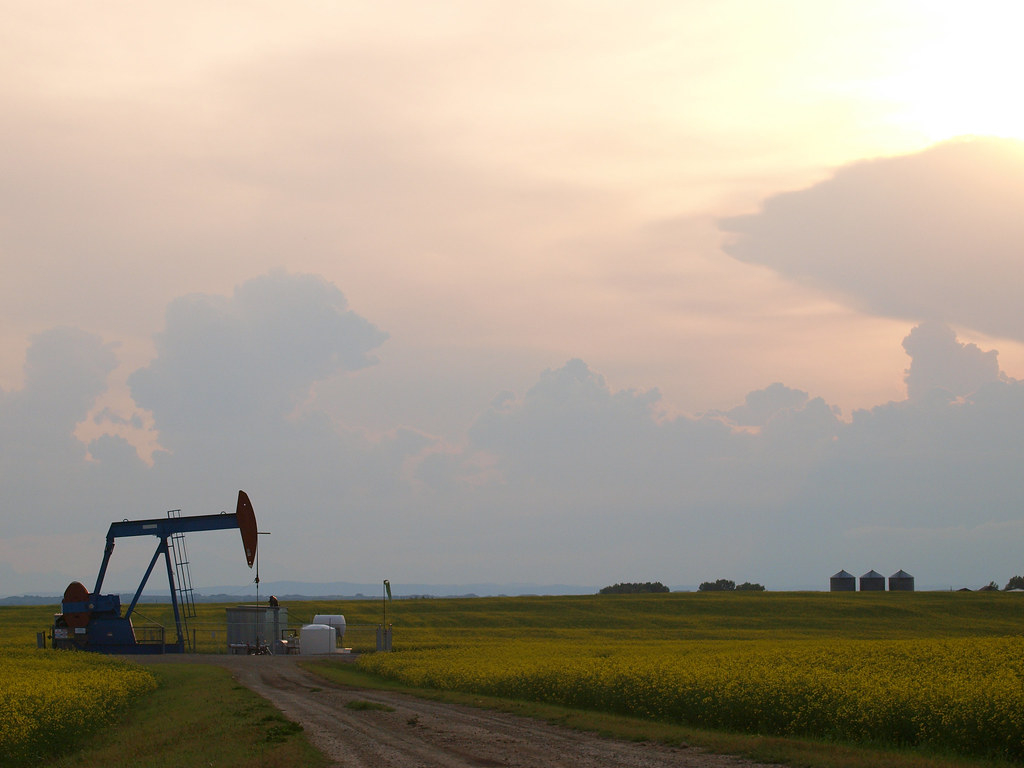
If B.C. shows how structural pressures compound, Alberta shows how quickly a single commodity swing can rewrite a province’s fiscal story. Alberta’s budget assumed West Texas Intermediate oil averaging just US$61 per barrel in 2026-27, producing a projected deficit equivalent to 1.8% of GDP. But those assumptions were set before the Middle East conflict pushed oil prices higher. RBC’s current forecast has WTI averaging almost US$80 in 2026-27, and the Business Council piece notes crude values have moved near $100 a barrel. Using Alberta’s own published fiscal sensitivities, RBC calculates that gap could be worth an additional $13 billion in-year revenue — enough to flip Alberta’s budgeted deficit into a 1.2% of GDP surplus. Saskatchewan and Newfoundland could see smaller, similar improvements. RBC frames this as a textbook example of how oil price shocks produce large distributional effects across the Canadian economy even when the aggregate national growth impact is close to neutral.
Atlantic Canada’s Widening Gap
While Alberta has a commodity cushion, the Atlantic provinces do not. RBC’s fiscal roundup singles out New Brunswick, Prince Edward Island and Nova Scotia for the most significant deficit deterioration of the budget round, again driven largely by higher health-care spending. All three now expect to still be running deficits above 1% of GDP by 2028-29, and RBC notes their 2026 budgets bake in sizeable increases to net debt-to-GDP relative to 2024-25 — a heavier burden landing on provinces that already carried higher-than-average debt loads. This marks a genuine reversal for New Brunswick specifically. RBC’s review of New Brunswick’s 2025 budget had already flagged the province’s pivot away from a recent run of surpluses, with a projected $599 million deficit in 2025-26 following a $399 million shortfall in 2024-25 — a sharp revision from an initially reported $41 million surplus. That budget cited general government programs, debt charges, a new contingency reserve, and health care as the main drivers, with public debt charges alone approaching $700 million, nearly three times what was allocated to the province’s Housing Corporation. RBC noted at the time that New Brunswick’s nominal GDP assumptions didn’t fully account for U.S. tariffs or Canadian countermeasures, calling that a downside risk to revenue — a risk that appears to have materialized into the deeper deterioration RBC is now reporting a year later.
Trade War Shadow Over the Forecasts
Tariffs sit over all of this as an unresolved variable. RBC’s macroeconomic outlook describes the effective average U.S. tariff rate briefly reaching its highest level since the 1930s after blanket 25% tariffs on Canada and Mexico earlier this year, before those were partly unwound for goods compliant with CUSMA. RBC estimates over 90% of Canadian exports to the U.S. should ultimately qualify for tariff-free treatment under CUSMA rules, even though only 38% of exports actually used CUSMA last year, largely because non-CUSMA tariff rates were already zero for many goods. Still, about 6% of exports — including a large chunk of the aerospace sector — aren’t protected under the deal, and sector-specific tariffs on steel and aluminum look likely to persist. Canada’s retaliatory tariffs, covering an additional $30 billion of imports in response to the steel and aluminum measures, will raise costs for Canadian buyers, particularly since roughly half of the targeted goods are themselves steel and aluminum products with few alternative suppliers.

The Business Council of Canada’s review of this budget season makes the connection explicit: continued uncertainty tied to the upcoming review of the Canada-U.S.-Mexico trade agreement is holding back business investment, even as surging oil prices from the Middle East conflict complicate the inflation and interest rate picture the Bank of Canada has to navigate.
Our Take
What strikes us most about this budget season isn’t any single province’s numbers — it’s the consistency of the pattern across very different economies, from oil-rich Alberta to debt-light New Brunswick to high-tax B.C. When nine provinces with wildly different revenue bases and political stripes all land on the same conclusion — spending pressures, not weak economies, are driving deficits — it suggests something structural rather than cyclical is underway. Healthcare’s climb toward roughly half of some provincial budgets, flagged in both the RBC and Business Council reporting, looks less like a temporary post-pandemic bulge and more like the early stage of a demographic bill that will keep coming due as the baby boomer cohort ages, a dynamic RBC’s fiscal team has flagged before as still in its early days.
For Canadian businesses, we think the more immediate concern is what these budgets are not funding. B.C.’s own document illustrates the trade-off starkly: billions flow to health and social programs while the investment-focused spending meant to diversify exports and attract private capital amounts to a comparatively modest few hundred million dollars. If that pattern holds across other provinces as their 2026 budgets land, it raises a real question about whether provincial fiscal policy is positioned to help Canadian exporters and manufacturers absorb the tariff shock RBC describes, or whether it will mostly be absorbed by health ministries and debt-servicing costs instead.
For consumers, the near-term signal is tax measures like B.C.’s bracket changes and PST base expansion — modest individually, but arriving at what the RBC analysis calls a moment of heightened competition for investment and talent, when Canadian taxation is already comparatively high. Whether other provinces follow with their own revenue measures as budget season continues is, in our view, one of the more consequential open questions hanging over Ottawa’s own April 28 update.
And for anyone watching Alberta specifically, the oil price swing RBC lays out is a reminder of just how much of Canada’s fiscal picture still rests on a single volatile commodity: the same set of assumptions that produced a budgeted 1.8%-of-GDP deficit could, at current prices, just as easily produce a surplus. That kind of swing is a gift if it materializes — but it is not, in our view, a substitute for the structural spending questions every other province is now being forced to confront.
This is a Commentary piece: analysis and editorial perspective from Canadian Business News, clearly distinguished above from the reported facts it’s based on. It is not financial, investment, or legal advice.
Sources