
Canada’s housing affordability crisis has become one of the dominant economic stories of the year, and a growing chorus of policymakers, economists and researchers now agree on one point: the problem will not be solved by the Bank of Canada’s interest rate alone.
Speaking to the Greater Victoria Chamber of Commerce and CFA Society Victoria, Bank of Canada senior deputy governor Carolyn Rogers said the central bank’s policy rate is “too blunt” an instrument to restore affordability. The bank has held its benchmark rate at 2.25 percent since last October while assessing trade uncertainty tied to the U.S. and the war in Iran. Rogers noted that lower rates push prices up while higher borrowing costs shut buyers out, and that a single national rate cannot be tailored to the needs of different regional housing markets. “This is the heart of the housing affordability dilemma and why it’s so hard to fix,” Rogers said, adding that housing is now “deeply intertwined with household wealth, the stability of our financial system and the strength of our economy.”
A Sector That Has Outgrown the Economy
Rogers pointed to a striking shift in Canada’s economic structure: in 2000, residential investment made up 4.3 percent of GDP while business investment in machinery, equipment and innovation stood at 8.3 percent. That relationship has since reversed. Writing in The Hub, economist Charles Lammam put the 2024 figures at 7.6 percent of GDP for residential structures versus 5.7 percent for machinery, equipment and intellectual property. Lammam pointed to tax settings such as the unlimited principal residence capital gains exemption, lighter bank capital requirements for mortgages compared with business loans, and CMHC’s mortgage insurance framework as factors steering capital toward housing over productive investment. Real estate, rental and leasing now accounts for roughly 13 percent of GDP but employs fewer than 2 percent of Canadians, according to the same reporting. Household debt sits at 103 percent of GDP, the highest in the G7, with 3.1 million mortgages due for renewal by the end of 2027.
Capital Economics, in a note cited by The Hub, forecast only two quarter-point rate increases starting next year, bringing the policy rate to 2.75 percent — well below the roughly 1.25 percentage points of tightening markets were pricing in by the end of 2027. The firm cited a sluggish economy weighed down by trade friction and slower population growth as reasons the bank has little room to move aggressively.
Supply, Zoning and Municipal Red Tape
While the Bank of Canada frames the issue partly as one of capital allocation, other analysts point squarely at supply constraints created by municipal regulation. Anthony De Luca-Baratta of the Macdonald-Laurier Institute cited CMHC research using its Municipal Land Use and Regulation Index, which found that a 10 percent increase in regulatory restrictiveness is associated with a 14 percent jump in home prices. He noted that the C.D. Howe Institute estimates a single-detached home in Toronto costs $350,000 more to buy than to build, even allowing for a 17 percent profit margin; in Vancouver, that gap reaches $1.3 million, and in British Columbia municipalities such as Abbotsford-Mission, Kelowna and Victoria, it ranges from $255,000 to $415,000. De Luca-Baratta also noted that Canada’s average home price rose from $163,524 in 2000 to $718,400 in 2025, a 339 percent increase, compared with general inflation of 55 percent over the same period.
Local Progress and Political Reversals
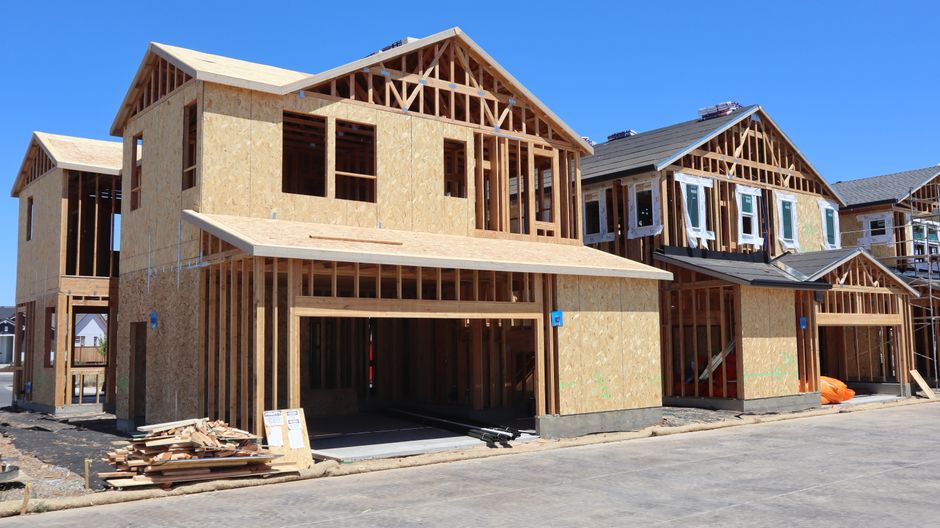
Some cities are narrowing the supply gap. In Calgary, CMHC’s latest estimate found the number of additional annual housing units needed by 2036 to restore pre-pandemic affordability has been cut in half, to between 4,000 and 5,000 units a year, thanks to record construction. CMHC’s lead Prairies economist, Taylor Pardy, said the city recorded 27,000 housing starts last year as part of three consecutive years of record construction, and is on pace for about 19,000 new homes this year. However, CMHC also noted total housing starts have declined more than 20 percent as projects begun in recent years reach completion, citing rising vacancy rates, growing inventories and higher construction costs.
The trajectory is complicated by local politics. Calgary’s current city council voted to repeal citywide rezoning that had allowed duplexes, rowhomes and townhouses without a public hearing, a move that will redesignate 306,774 residential properties back to lower-density zoning. Alex McColl of More Neighbours Calgary called the narrowing supply gap “a good thing” but warned that “repeal without replacement reverses the conditions that increase housing supply.” Mayor Jeromy Farkas defended the reversal, saying a one-size-fits-all approach was not appropriate given existing infrastructure.
Federal Moves to Protect Existing Affordable Units
Ottawa has also moved to shore up the existing affordable housing stock rather than only encourage new construction. The federal government has launched a $1.5 billion Canada Rental Protection Fund under Build Canada Homes, managed by the non-profit Canadian Housing Acquisition Fund, aiming to help community housing organizations acquire vulnerable apartment buildings and protect at least 7,000 affordable rental units nationwide over five years. Housing Minister Gregor Robertson said the fund is meant to help “preserve affordable homes and ensur[e] more Canadians can remain in their communities,” while Build Canada Homes CEO Ana Bailão said the program reflects “a sector-led model.” In Toronto’s Regent Park redevelopment, the non-profit Fred Victor was selected to acquire and operate about 65 affordable rental homes within a new condominium tower, an example officials point to as a model for combining market and non-market housing.
Together, the sources suggest a policy landscape in flux: a central bank explicitly stepping back from using rates to target home prices, economists pointing to tax and capital rules that favour housing investment, municipalities wrestling with zoning reversals, and federal programs focused on protecting existing affordable stock even as new construction slows in some markets.
This article references reporting from: